Oral Presentation International Celiac Disease Symposium 2026
TEV-53408, an Anti-IL-15, Significantly Attenuated Gluten-Induced Villous Change in Adults With Celiac Disease: Results From a Phase 2a Randomized, Placebo-Controlled Study (#119)
Background: This phase 2a study evaluated the efficacy and safety of TEV-53408, an anti-IL-15 monoclonal antibody, to attenuate the effects of gluten in adults with celiac disease.
Methods: This randomized, double-blind, placebo-controlled study enrolled adults (18-65 years) with celiac disease on a gluten-free diet for ≥12 months, minimal enteropathy at baseline [villous height-to-crypt depth ratio (Vh:Cd) ≥2], no moderate/severe gastrointestinal symptoms, and HLA-DQ2/DQ8 positivity. Participants were randomized 1:1 to a single subcutaneous dose of TEV-53408 or placebo; two weeks later, participants initiated a 6-week gluten challenge (3 g/day). The primary endpoint was change from baseline in Vh:Cd at Week 8. Secondary endpoints included changes in intraepithelial lymphocyte (IEL) density and VCIEL, a composite of Vh:Cd and IEL density. Exploratory endpoints included daily celiac disease symptom diary (CDSD) scores and tissue biomarkers. Efficacy endpoints were analyzed using ANCOVA in the mITT population of completers (participants having both a baseline and a post-gluten challenge biopsy at Week 8).
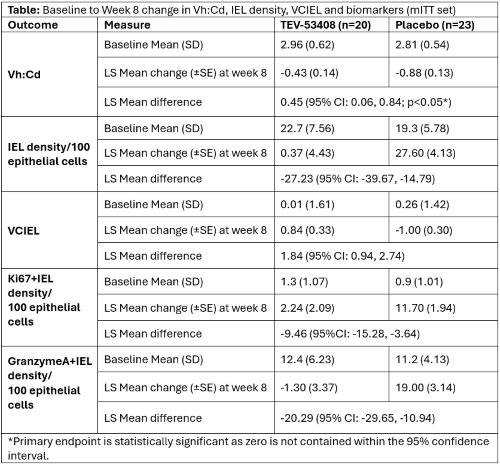
Results: Fifty participants were randomized (safety set); 43 comprised the mITT set. Mean age was 41 years, 81% female, and mean time since diagnosis was 9.1 years. At Week 8, Vh:Cd declined significantly less with TEV-53408 than placebo. Favorable changes in IEL density, VCIEL, and associated tissue biomarkers were observed (Table). Following gluten challenge, CDSD scores remained stable with TEV-53408 but worsened with placebo. Treatment-emergent adverse events (AEs) were similar across arms. No serious AEs occurred. Fewer participants experienced gastrointestinal (56% versus 72%) and infection-related (28% versus 44%) treatment-emergent AEs with TEV-53408 than placebo.
Conclusion: TEV-53408 significantly attenuated gluten-induced villous change, as measured by Vh:Cd, compared with placebo. Findings were further supported by improvements in inflammatory measures and biomarkers. TEV-53408 was safe and well-tolerated. Together, these findings highlight TEV-53408 as a promising therapy for adults with celiac disease beyond dietary management.