Poster Presentation International Celiac Disease Symposium 2026
Analysis of clonality and longevity of disease-related gut plasma cells in celiac disease: Evidence for persistence of clonotypes (#368)
Background: Plasma cells (PCs) reactive toward transglutaminase 2 (TG2) and deamidated gluten peptide (DGP) are abundant in celiac lesions. Most of these PCs have a short-lived phenotype (CD19+CD45+), lack CD27 expression (a memory B-cell marker) and possess relatively few mutations. These observations have raised suspicion of recruitment from naïve B cells. However, contributions from memory B cells remain possible. This study aimed to address this issue.
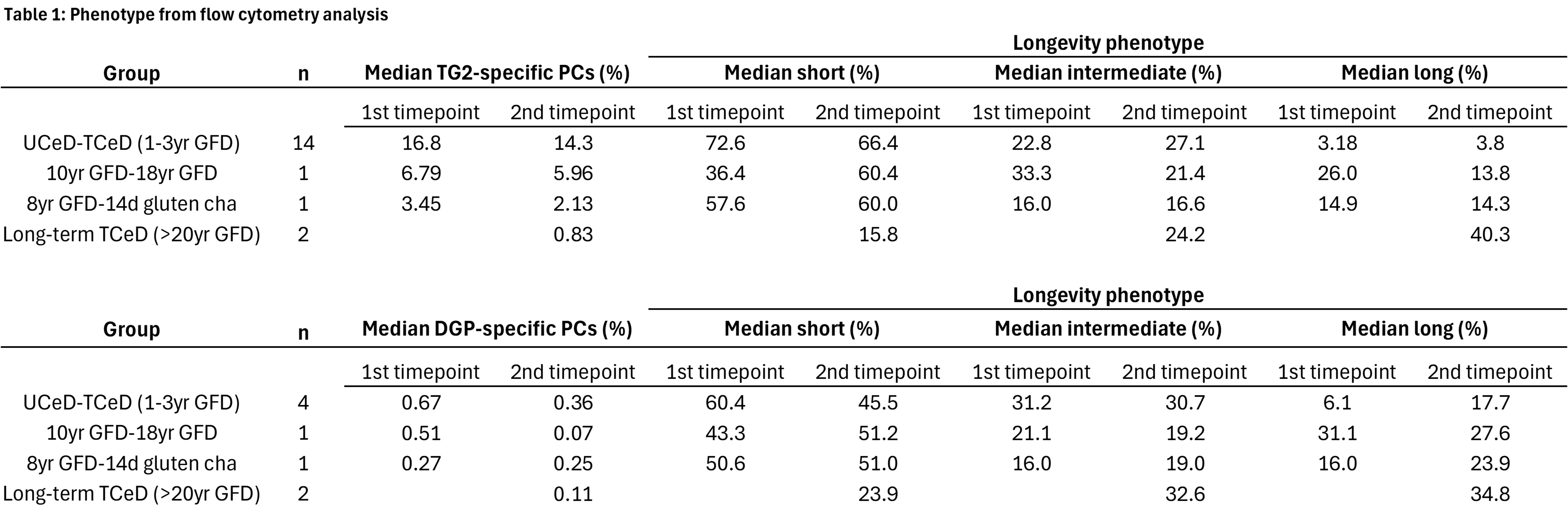
Materials and methods: We examined duodenal biopsy samples of celiac disease (CeD) subjects: 14 paired samples (untreated vs treated on a gluten-free diet, GFD) and four long-term treated (two with paired samples, 10yr GFD-18yr GFD and 8yr GFD-14-day gluten challenge) (Table1). From single-cell suspensions, antigen-specific PCs were single-cell sorted for paired B-cell receptor sequencing. Clonality of a total of 2,396 (2,163 for TG2 and 233 for DGP) cells in relation to expression of longevity markers (CD19/CD45) was investigated.
Results: For untreated CeD vs treated CeD, the frequency of antigen-specific PCs decreased slightly (Table1). The majority of antigen-specific PCs was clonally expanded, and larger clonotypes showed extensive sharing between sampling timepoints (medians of 46.8% for TG2 and 50% for DGP clonotypes were shared between timepoints). Short-lived PCs dominated the clonal trees of PCs, yet intermediate (CD19-CD45+) and long-lived (CD19-CD45-) PCs were also present. Within the first years of treatment, the distribution of longevity phenotypes between single and expanded clonotypes was similar with minimal change of diversity suggesting little replacement of clonotypes. For the two long-term treated subjects investigated at two timepoints, the frequency of antigen-specific PCs was lower, with the long-lived phenotype dominating. Shared clonotypes were observed between timepoints, albeit at a lower frequency.
Conclusion: Persistence for years of TG2- and DGP-specific clonotypes with representation of distinct longevity markers in clonal trees suggests that memory B cells contribute to disease-related PC populations in CeD.