Poster Presentation International Celiac Disease Symposium 2026
Risk factors for immune-mediated multimorbidity and familial clusters of disease in patients with celiac disease (#362)
Introduction: Celiac disease (CeD) is associated with increased risk of several immune-mediated disorders. Growing evidence has also identified the clustering of certain health conditions within families. However, there is limited research investigating if certain autoimmune immune-mediated cluster in families among patients with CeD.
Methods: We conducted a retrospective study on adult CeD patients at an Italian centre (Padova). Data for these patients include age, gender, and years since onset of symptoms to CeD diagnosis. Additionally, immune-mediated comorbidities of their own and their family members were recorded. Logistic regression was performed to estimate factors associated with having an additional autoimmune disorder. We also utilized the clustAnalytics package to assess the significance and stability of familial disease clusters compared to a null model.
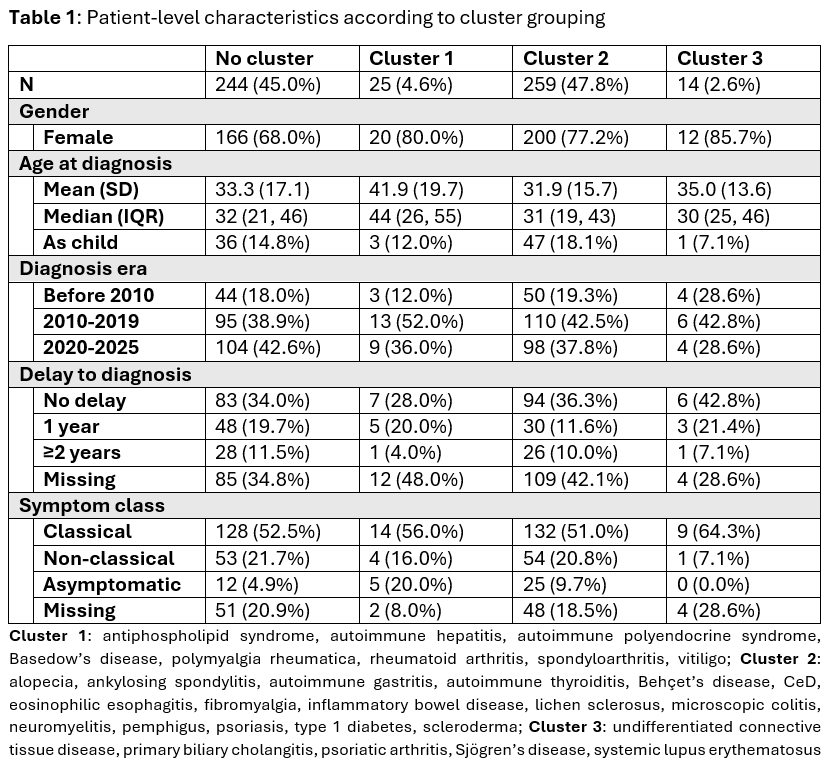
Results: Almost one-third (31.9%) of the cohort had at least one other immune-mediated comorbidity. Females were more likely to have a comorbidity compared to males (p<0.001). A total of 298 (55.0%) patients had sufficient data on comorbidities and/or familial diseases to contribute data for clustering analysis. Three clusters were identified from the model (Table 1). Almost half of patients were primarily linked to Cluster 2, with another large portion not belonging to a cluster given no comorbidity themselves or among their family members. The modularity demonstrated a higher value (0.18) versus the random 1000 null networks (0.02) in every instance (percentile rank=1.00), suggesting modest but truly meaningful and distinct disease clusters.
Conclusion: Clustering of immune-mediated comorbidities within families of patients with CeD are not randomly distributed; however, these clusters are not distinctly separate and are interconnected with others. Further research is recommended on whole familial networks to more clearly determine connected conditions.