Elevated Poster Presentation International Celiac Disease Symposium 2026
Reframing Celiac Disease Diagnostics in an Emerging Therapeutics Era (#74)
Introduction: Variability exists among the diagnostic guidelines for celiac disease (CeD), with emerging evidence and ongoing conversation surrounding acceptable diagnostic algorithms – conventional vs biopsy-free approach. In clinical practice, significant heterogeneity exists both in how CeD patients are diagnosed and the level of data available to support diagnosis. In contrast, per FDA guidance, clinical trials continue to rely on documentation of biopsy-proven CeD for trial eligibility. This study aims to review the real-world diagnostic data available for patients with a CeD diagnosis.
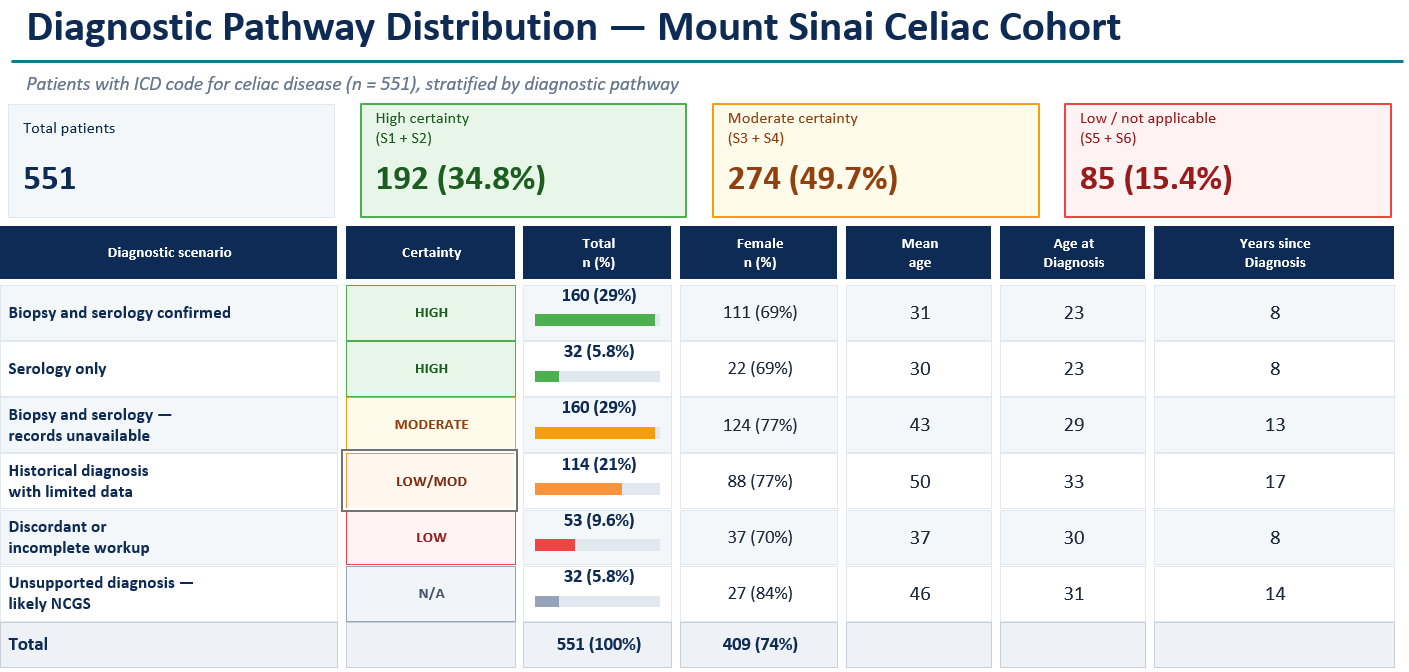
Methods: We conducted a retrospective observational study to characterize the diagnostic patterns and available diagnostic documentation in the electronic medical records for a large tertiary care hospital in New York City. We reviewed patients with an ICD diagnosis of CeD and stratified patients by available diagnostic data – confirmed biopsy and serology (S1), serology-only in accordance with a biopsy-free approach (S2), unavailable historical records with high (S3) and low (S4) degrees of confidence, discordant results/incomplete workup (S5), and patient-reported gluten sensitivity (S6).
Results: Among 551 patients, 29% had documentation of a biopsy and serology confirmed CeD diagnosis within the EMR, and 5.8% qualified for serology-only diagnosis via biopsy-free approach. An additional 29% had high confidence documentation of biopsy confirmed CeD despite unavailable historical records. The remaining patients had low confidence historical diagnosis with very limited data (21%), inaccurate diagnosis (discordant results/incomplete work-up) (9.6%), or unsupported diagnosis consistent with patient-reported gluten sensitivity (5.8%).
Conclusion: Diagnostic documentation for CeD is highly variable in clinical practice, and many patients lack objective documentation of biopsy-confirmed disease within the electronic medical records. These findings highlight an important gap between evolving real-world diagnostic practices and the eligibility criteria used in therapeutic clinical trials. Future studies should evaluate how this discrepancy may influence the generalizability of clinical trial results and access to emerging therapies.
- U.S. Food and Drug Administration. Celiac Disease: Developing Drugs for Adjunctive Treatment to a Gluten-Free Diet — Guidance for Industry (Draft). CDER/CBER, April 2022. Available at: www.fda.gov/media/157682/download
- Rubio-Tapia A, Hill ID, Semrad C, et al. American College of Gastroenterology Guidelines Update: Diagnosis and Management of Celiac Disease. Am J Gastroenterol. 2023;118(1):59–76.
- Lebwohl B. Moving Away From Biopsy Confirmation of Celiac Disease. Gastroenterology. 2024;166(4):557–558.
- Jansson-Knodell CL, et al. Non-Biopsy Diagnosis of Adult Celiac Disease in the United States. DDW ePoster Abstract #415304, May 2024. Available at: eposters.ddw.org/ddw/2024/ddw-2024/415304
- Shiha MG, Nandi N, Raju SA, et al. Accuracy of the No-Biopsy Approach for the Diagnosis of Celiac Disease in Adults: A Systematic Review and Meta-Analysis. Gastroenterology. 2024;166(4):620–630.