Elevated Poster Presentation International Celiac Disease Symposium 2026
A Continuous Composite Endpoint Methodology Improves Clinical Trial Efficiency for Celiac Disease (#75)
Background
This study extends our previously reported VCIEL composite for Vh:Cd and IEL by designing a continuous composite endpoint (CCE) methodology to include additional immunologic biomarkers relevant to celiac disease. The aim is to improve statistical power and efficiency for clinical trial endpoints by creating an integrated metric combining heterogeneous indicators with equal weight.
Methods
Continuous composite endpoint (CCE) scores were constructed by standardizing individual histologic, immunologic, and serologic measurements to a common scale before combining them into a single continuous endpoint. For each participant, the CCE score was calculated as:
CCE score = (1/n½)∑1n Si (Ii - ⟨Ii⟩)/σIi
where n represents the number of predefined component variables, Ii is the observed value for component i; ⟨Ii⟩ and σIi are the corresponding baseline mean and standard deviation, and Si is a directionality factor (+1 or -1) used to ensure that all components change in the same biological direction. Biomarkers that increase with worsening disease (e.g., IEL and serology) were assigned positive directionality, whereas biomarkers that decrease with worsening disease (e.g., Vh:Cd) were assigned negative directionality.
Results and Conclusions
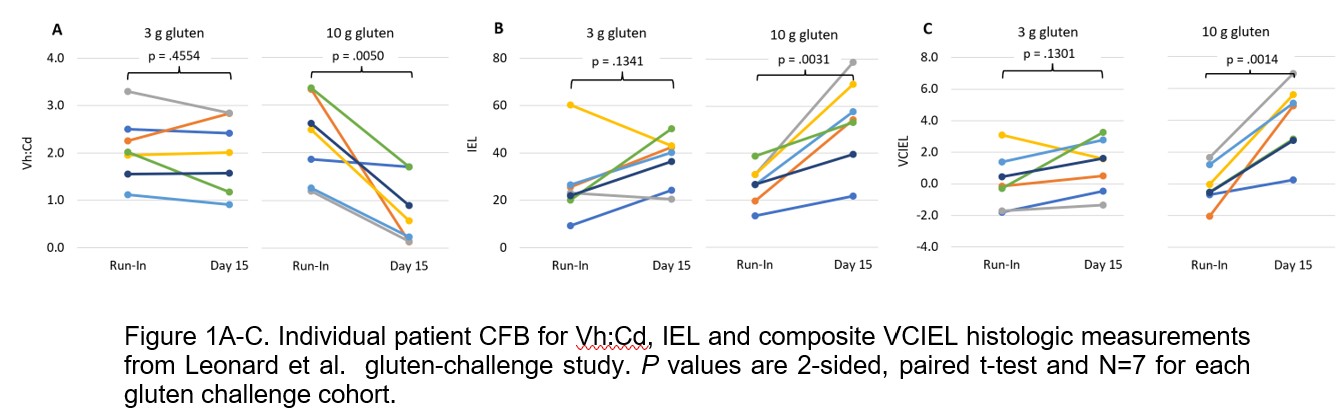
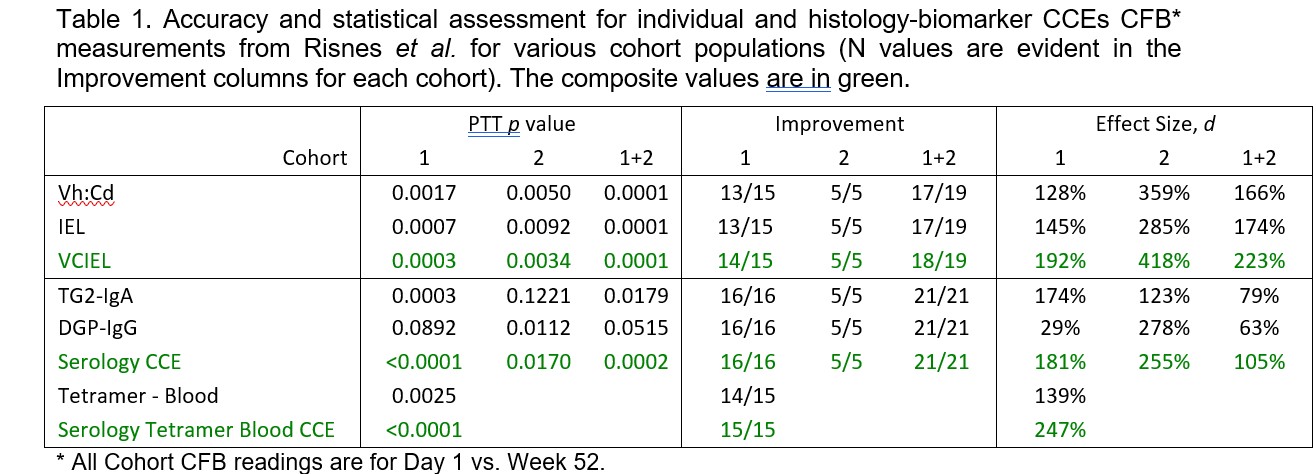
CCE scores were generated using two clinical datasets. (1) Leonard et al. (2021) CCE components were: (i) VCIEL (Vh:Cd + IEL); (ii) ELISpot interferon-γ ; (iii) flow-cytometric HLA-DQ2.5:gluten tetramer-positive CD4+ T cells and CD8+ α4β7+CD38+ cells; (iv) in vivo interleukin-2; and (v) serology. (2) Risnes et al. (2024) CCS components were: (i) VCIEL; (ii) tetramer-positive CD4+ TEM cells in blood and gut; (iii) %CD38 expression of blood tetramer+ TEM cells; and (iv) an integrated composite combining serology and tetramer metrics. Change from baseline to end of study served as the primary outcome. In both studies, VCIEL improved statistical precision and effect size relative to individual histologic measures (Figure 1), and composite biomarker scores consistently outperformed their individual components (Table I).