Poster Presentation International Celiac Disease Symposium 2026
Population screening in Norway: Who are detected by screening compared to routine care? (#232)
Background/aim:
The diagnosis of CeD requires access to and use of available health care. Within the frame of population screening for CeD, we studied socio-demographic characteristics in those diagnosed in routine health care and in screening.
Methods:
In the Norwegian population-based HUNT study, 56,039 participants from age 19 were screened for transglutaminase IgA-antibodies. A complete diagnosis was confirmed by Marsh grade 3 in a small-bowel biopsy in seropositive participants. Participants with a diagnosis at baseline detected in routine care were identified through hospital chart review. In logistic regression models we examined whether sex, education, income, and residency were associated with CeD diagnosed by screening or routine health care, and with the overall CeD risk.
Results:
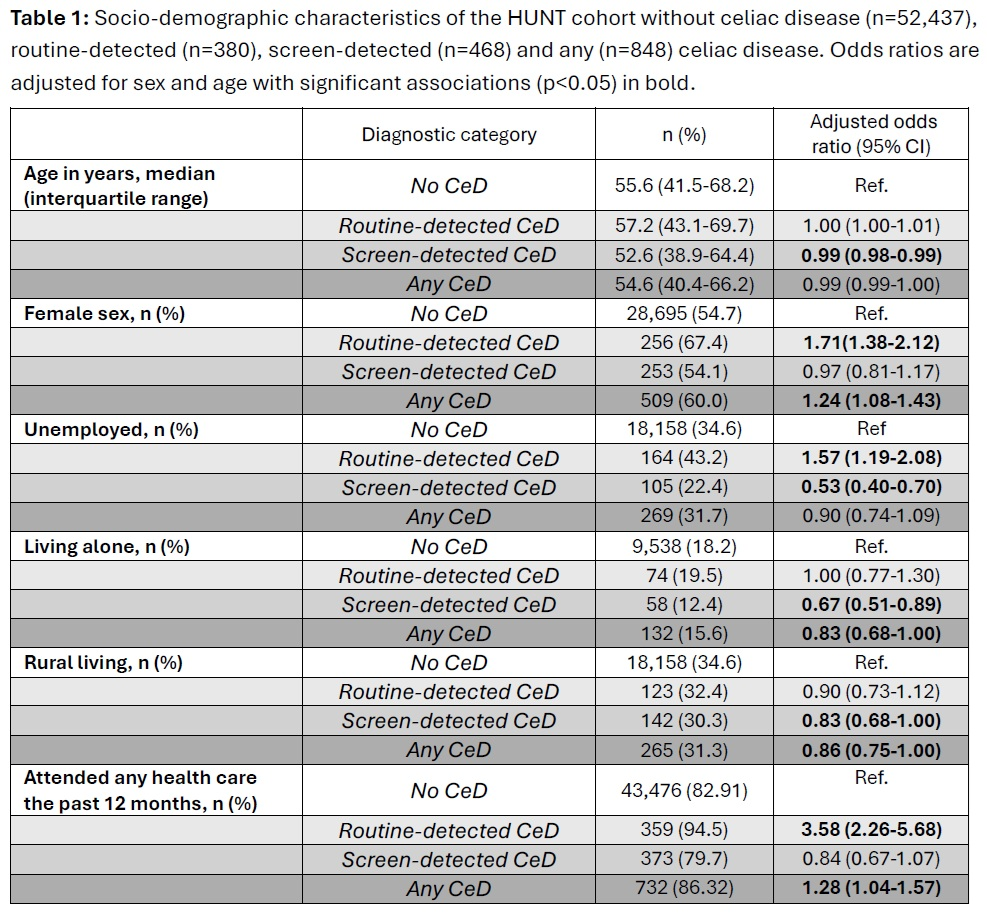
Overall, 848 participants (1.51%) had CeD with a median age of 54.6 years. Of these, 380 (0.68%) had CeD at baseline, whereas 468/56,039 (0.84%) were diagnosed by screening. Females had a higher risk of routine-care-detected but not screening-detected CeD (Table).
Education level was not associated with routine-care-detected CeD (ptrend=0.21) but lower education was associated with lower likelihood of CeD by screening (ptrend=0.001). Higher income was associated with increased risk of routine-care-detected CeD (ptrend=0.036), but lower risk of screening-detected CeD (ptrend<0.001). Being outside the workforce was positively associated with routine-care CeD but decreased likelihood of screening-detected CeD.
Living alone was not associated with CeD diagnosed in routine care but lower risk of screen-detected CeD. Rural living was associated with borderline lower risk of screening-detected CeD. Healthcare contact the past year was positively associated with routine-detected but not screening-detected CeD.
CeD overall was positively associated with female sex and higher education and negatively associated with living alone and rural residence (Table).
Conclusions:
Socio-demographic characteristics differed between cases diagnosed in routine care and screening; a disadvantaged social position decreased the likelihood of screening-detected CeD.