Oral Presentation International Celiac Disease Symposium 2026
Less than half of patients newly positive for tissue transglutaminase antibodies undergo upper endoscopy for diagnostic confirmation: A population-based study from Alberta, Canada (#23)
Background: Diagnostic guidelines for celiac disease (CeD) have supported greater reliance on serological diagnosis over the last decade. However, the degree to which patients with elevated tissue transglutaminase antibodies (tTG-IgA) still undergo upper gastrointestinal endoscopy (EGD) for diagnostic confirmation in real-world settings is limited.
Methods: Individuals newly positive for tTG-IgA between 2023–2024 were identified from a laboratory database in Alberta, Canada. Patients were linked to their EGD and corresponding pathology records from an electronic medical record system within one year of their index tTG-IgA test. Pathology reports were independently reviewed in duplicate to classify biopsy-confirmed CeD (at least Marsh 3). Outcomes were compared across patient characteristics including sex, age, geographic location, aggregate socioeconomic measures, and baseline tTG-IgA levels.
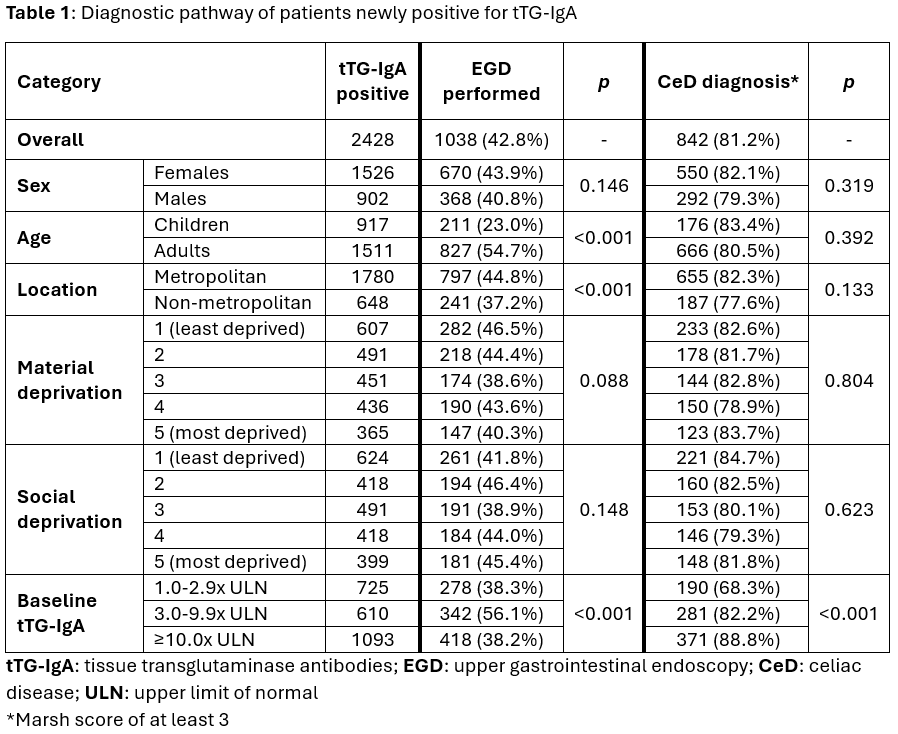
Results: Of 2428 individuals positive for tTG-IgA, 1038 (42.8%) were linked to a pathology record (Table 1). Approximately one-quarter (23.0%) of children had an EGD compared to just over half (54.7%) of adults (p<0.001). Patients living in metropolitan areas were slightly more likely to have an EGD (44.8%) than those in rural areas (37.2%; p<0.001). Over half (56.1%) of patients with tTG-IgA levels 3.0–9.9 times the upper limit of normal (ULN) had an EGD; those with tTG-IgA 1.0–2.9 times the ULN or ≥10.0 times the ULN were less likely to receive an EGD (p<0.001). No major differences in EGD were observed by sex or across socioeconomic measures. Among patients with an EGD, 842 (81.2%) had biopsy-confirmed CeD. More patients with tTG-IgA ≥10.0 times the ULN (88.8%) had biopsy-confirmed CeD compared to those with tTG-IgA 1.0–2.9 times the ULN (68.3%; p<0.001)
Discussion: Within one year of tTG-IgA positivity, less than half of patients—and only one-quarter of children—have an EGD to investigate for CeD. Further surveillance on biopsy-confirmed and serologically positive only patients is warranted to understand if long-term outcomes differ between groups.