Poster Presentation International Celiac Disease Symposium 2026
SERONEGATIVE CELIAC DISEASE: IS IT A MARKER OF SEVERE/ EXTRAINTESTINAL DISEASE? (#243)
OBJECTIVES : To explore the phenotype at presentation and outcomes of children with True Seronegative Celiac Disease
METHODS: All children presenting with Villous Atrophy, negative anti tTG IgA, normal IgA levels& negative tTG-IgG / DGP-IgG antibodies& unequivocal response to strict gluten free diet& at least 2 years follow-up were included. All included children had a normal primary immunodeficiency work up and no other etiology explaining the clinical presentation
RESULTS:
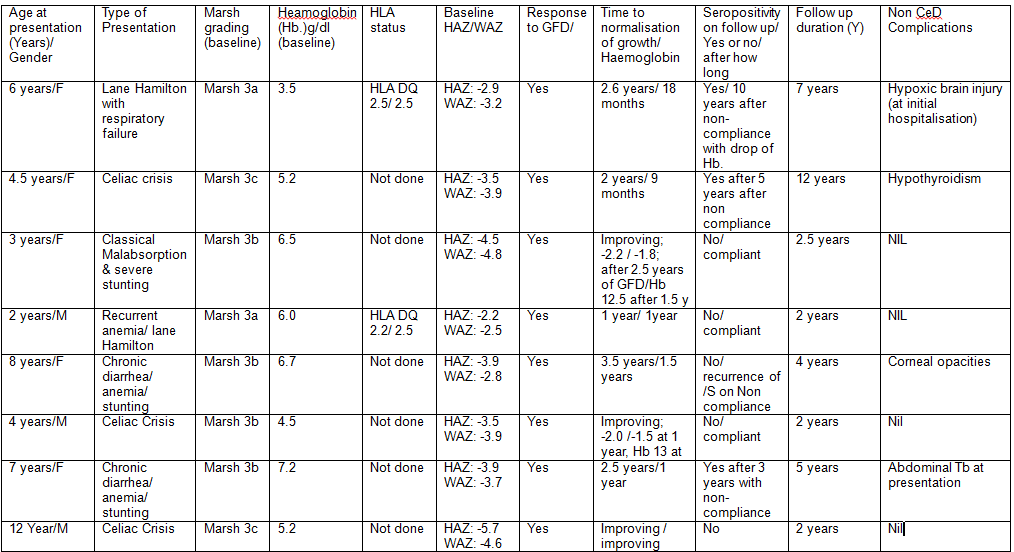
Eight consecutive children with Seronegative Celiac Disease(SNCeD), between 2019-2025 were analysed. Data was retrieved from meticulously maintained records. A total of 1720 children new children with celiac disease were seen in the same period. The age range of the children with SNCeD was 2-12 years. There were 5 girls& 3 boys. Three had presented with celiac crisis, 2 with Lane Hamilton syndrome and 3 had a classicalCeD. All children had a negative work up for primary immunodeficiency(done before discharge/within 3 months of presentation). All children with Celiac Crisis had low immunoglobulin levels which recovered after resolution of the acute illness. The mean age was: 5.8+2.9; The haemoglobin was 5.6+1.2; HAZ at presentation was: -3.8+0.98; All children responded to GFD with resolution of complications, improvement in growth, haemoglobin& symptoms. All children were checked for Celiac Serology twice a year. Three of the eight had documented seropositivity of anti tTGA antibodies at 3, 5& 10 years, when they became non-compliant. Repeat duodenal biopsy was done in all 8 children after 2 years on a GFD; Normalisation of Villous atrophy was documented with V:C ratio > 2 in 4 children(patient 1, 2, 4, 7). All four regained normal height within 3 years.
CONCLUSIONS: Seronegative Celiac disease may represent a severe phenotype where the antibodies are not released in the circulation, but antibodies may appear later once the child has shown clinical recovery.