Poster Presentation International Celiac Disease Symposium 2026
Inadequate nutritional intake in newly diagnosed celiac disease patients starting the gluten-free diet: a question of quality and quantity? (#203)
Background and aims:
A strict lifelong gluten-free diet (GFD) is the cornerstone in celiac disease (CeD) management. While effective for symptom control and intestinal recovery, the GFD may adversely affect nutritional quality (1,2). This study aimed to evaluate the nutritional adequacy of the GFD in newly diagnosed adults with CeD.
Methods:
A prospective, observational study was performed at the largest tertiary care center of Belgium. Four-day food diaries (including two week- and two weekend-days) were collected from 15 newly diagnosed adults with CeD. Nutrient intake was analyzed using Evry nutritional analysis software and compared with national dietary recommendations and reported average intakes in healthy Belgian adults (3,4). Differences were evaluated by unpaired t-test with Welch’s correction.
Results:
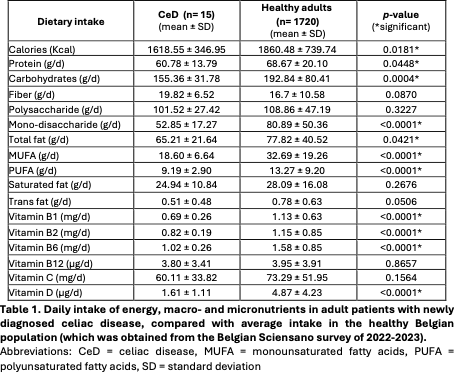
In total, 15 subjects (80% female) with a mean age of 40.9 years and BMI of 24.3 kg/m2 were included. Total intake of calories, carbohydrates, fats, proteins, vitamins B and D were significantly lower in CeD vs. controls (Table). Fiber intake was similar, but below the recommended intake of 25 g/day (3). Consumption of polysaccharides was preserved due to higher consumption of rice and potatoes. Finally, intake of saturated fat, trans fat and vitamins B12 and C did not differ between groups.
Conclusions:
Our data illustrates several challenges associated with starting a GFD. Overall, energy and macro- and micronutrients intake were reduced, likely due to limited available or perceived food options when starting with the GFD. Insufficient vitamin intake and the absence of fortification are also more concerning in case of malnutrition at diagnosis. Therefore, all newly diagnosed CeD patients should receive dietetic counselling beyond gluten avoidance, with a focus on achieving a nutritionally balanced diet.
- Hall NJ, Rubin G, Charnock A. Systematic review: adherence to a gluten-free diet in adult patients with coeliac disease. Aliment Pharmacol Ther. 2009 Aug 15;30(4):315-30.
- D'heedene M, Vanuytsel T, Wauters L. Celiac disease: Hope for new treatments beyond a gluten-free diet. Clin Nutr. 2024 Jun;43(6):1240-1249.
- Superior Health Council. Voedingsaanbevelingen Voor België - 2016. Brussels: Superior Health Council; 2016. Report No.: 9285.
- Sciensano: Food consumption survey 2022-2023: Evaluation of macro- and micronutrient intake in the Belgian population, Brussels, Belgium.