Poster Presentation International Celiac Disease Symposium 2026
Residential greenness and vegetation associated with celiac disease (#229)
Introduction: The incidence of celiac disease (CeD) has increased substantially over the last decades (1). It is not fully understood which environmental factors that trigger the increase (2). How the residential environment affects the risk of CeD is unclear. We aimed to study the effects of residential greenness and land cover types on the risk of CeD.
Methods: All biopsy- and serology-confirmed cases of CeD in the region of Skåne, southern Sweden, from 2010-2022 were included as previously described (3). Each case was randomly assigned 20 non-celiac controls matched by gender and 5-year age groups. Residential addresses at time of diagnosis were retrieved from registers. Yearly satellite data was collected during summer months on leaf area index (LAI), normalized difference vegetation index (NDVI) and land cover types, in areas of 500 and 1500 m around every individual’s residency (4). Logistic regression models were applied.
Results: A total of 2710 CeD cases and 54200 controls were included (mean age in both groups 28 years (range 0-94), 64% women). Higher greenness indices were associated with increased odds of CeD (NDVI 1500 m: OR 1.25, 95% CI 1.19–1.30; LAI 1500 m: OR 1.21, 95% CI 1.16–1.26). Similarly, each 10 percentage-point increase in vegetation cover was associated with increased odds of CeD (OR 1.36, 95% CI 1.29–1.43), whereas built areas were negatively associated (OR 0.90, 95% CI 0.89–0.91, Table 1). The findings were similar in children and adults. NDVI and LAI were strongly correlated (r=0.73), and both were positively correlated with forest and cropland, while negatively correlated with built areas.
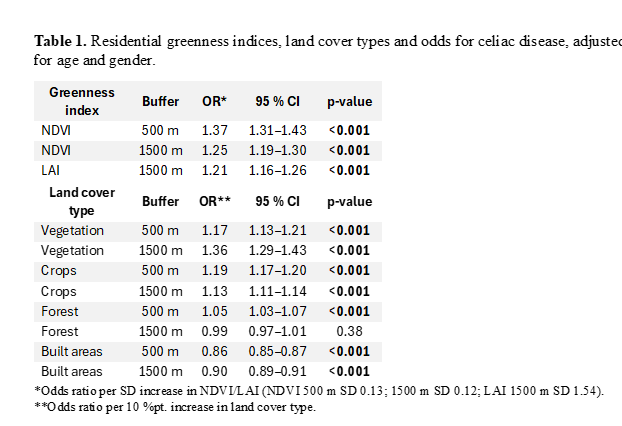
Conclusion: Living in areas with high residential greenness, and areas consisting of higher percentage of vegetation or crops, is associated with increased odds of CeD. Further research is needed to understand the mechanisms behind this association.
- King JA, Jeong J, Underwood FE, et al. Incidence of celiac disease is increasing over time: a systematic review and meta-analysis. Am J Gastroenterol. 2020;115(4):507–525.
- Lebwohl B, Sanders DS, Green PHR. Coeliac disease. Lancet. 2018;391(10115):70–81.
- Lexner J, Clarkson S, Sjöberg K. Decreasing incidence of celiac disease in Southern Sweden. Scand J Gastroenterol. 2024 Sep;59(9):1039-1048.
- Boström M, Roslund MI, Häme L, et al. Associations between residential greenness, land cover and risk of celiac disease in genetically at-risk children: Celiac Prediction in Skåne study. J Pediatr Gastroenterol Nutr. 2026 Apr 22.