Oral Presentation International Celiac Disease Symposium 2026
Accuracy of New European Adult Guidelines for Serology-Based Diagnosis of Celiac Disease in a United States Population (#59)
Background and Aims: We aimed to determine the diagnostic accuracy of the conditional recommendation for a non-biopsy diagnosis for adults (age <45) from the newly released European Society for the Study of Celiac Disease guidelines in a United States (US) adult population.
Methods: We performed a multicenter cohort study encompassing 6 academic medical centers across the US. Inclusion criteria were adults (≥18 years) evaluated for celiac with tissue transglutaminase immunoglobulin A antibody (tTG-IgA) and duodenal biopsy. Exclusion criteria were prior celiac diagnosis, IgA deficiency, and patients following a gluten-free diet. Celiac disease was defined as biopsy showing villous atrophy (Marsh ≥3). Diagnostic performance was measured with specificity, sensitivity, positive predictive value (PPV), and negative predictive value (NPV).
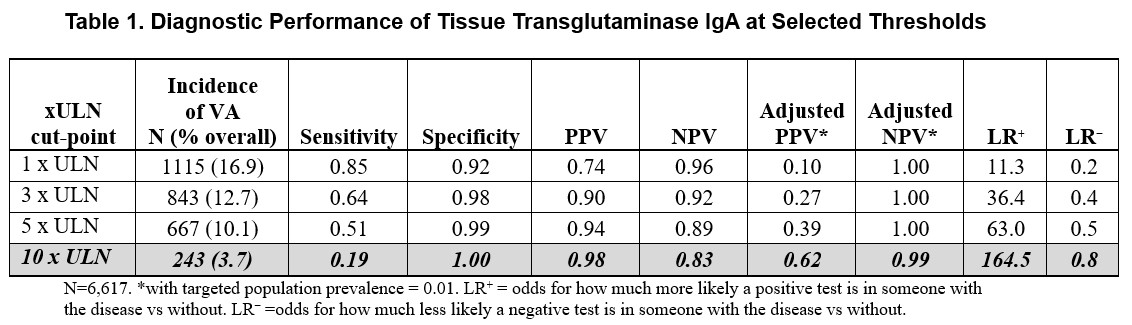
Results: A total of 13,374 patients were included with 6,617 between 18-45 years old. There were 515 patients with tTG-IgA ≥10x the upper limit of normal (ULN) in all age groups with 249 of those patients aged 18-45. All but 6 of those 249 patients had villous atrophy on biopsy (97.6%). The cutoff of ≥10x ULN was 99.8% (95% CI, 99.8%, 100%) specific for a diagnosis of celiac disease [Table 1]. The unadjusted PPV was 0.98. The sensitivity was 18.6% (95% CI, 16.5%, 20.7%) and the unadjusted NPV was 0.83. If a prevalence of 1% is assumed, the adjusted PPV was 0.62 and adjusted NPV was 0.99.
Conclusions: A tTG-IgA ≥10x ULN strongly correlates with villous atrophy suggesting the non-biopsy diagnosis proposed by European guidelines may be accurate in US adults; however, it would apply to approximately 20% of patients ultimately diagnosed with celiac disease and 4% of all patients evaluated for celiac disease in our sample.